
Higgsfield AI: what's it actually good for in a business?
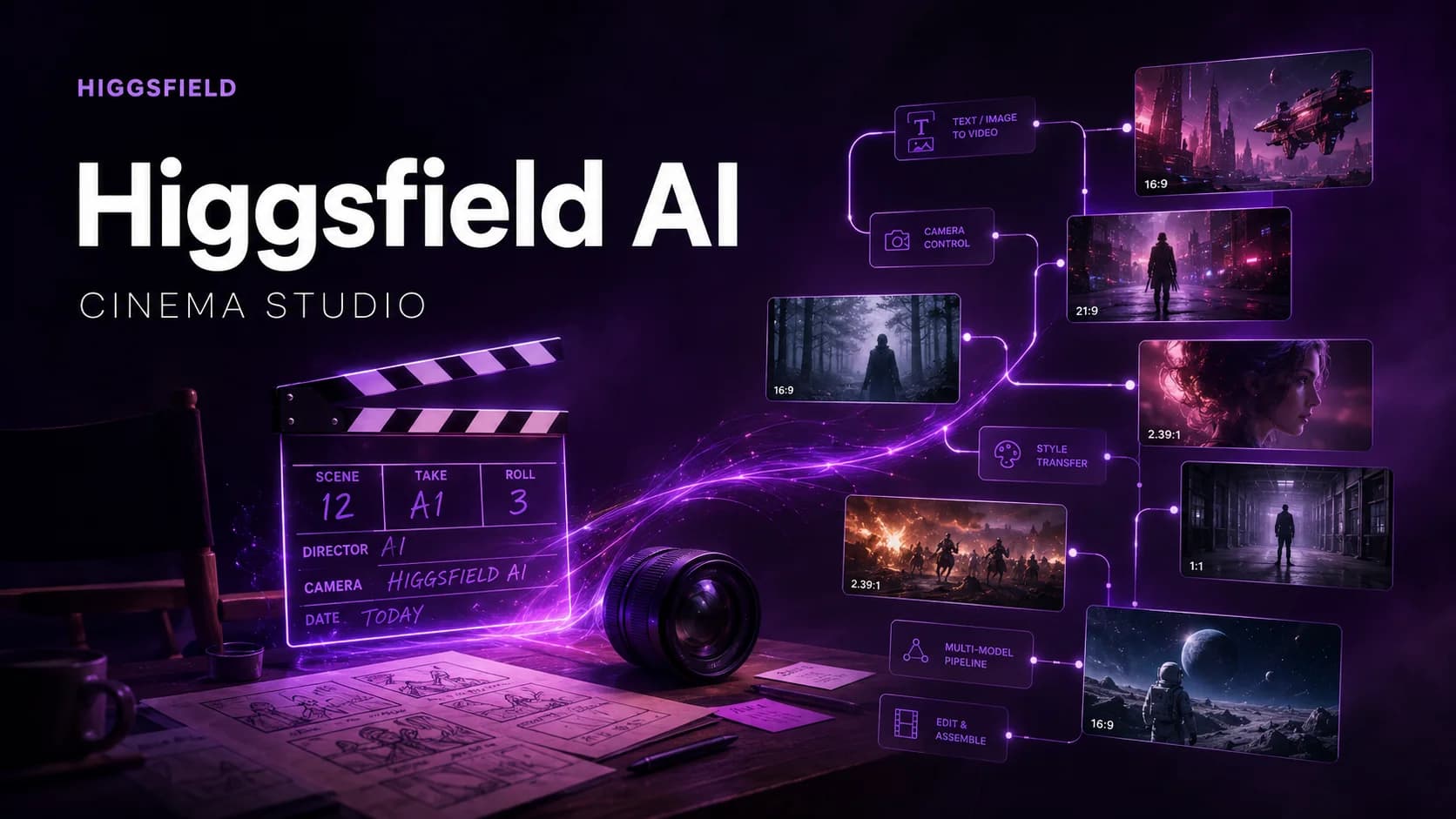
Higgsfield Cinema Studio is an all-in-one AI video workshop: it bundles 15+ leading video models (Sora 2, Google Veo 3.1, Kling 3.0, Seedance 2.0 and more) under a single subscription, plus its own character and location generation and a Claude-based "director" layer that turns a raw idea into a scene-by-scene, camera-move-level prompt. After analyzing several real workflows in detail, here's what actually works, and what the demo videos rarely say.
Pricing and scope in summer 2026
There are three annual subscription tiers: Starter at $15/month (200 credits), Plus at $39/month (1,000 credits), Ultra at $99/month (3,000 credits); monthly billing runs 50-60% higher. Separately purchased top-up credits (roughly 100 credits for $5) expire after 90 days and don't roll over. Cinema Studio 3.5's AI Director and its library of 70+ ready-made camera presets (Bullet Time, Crash Zoom, 360 Rotation, Dolly Shot, FPV) are, by most industry reviews, currently the most advanced camera simulation available on any AI video platform.
The three-step backbone
- Script: not a one-line request, but built interactively with Claude, question by question: how long, how many locations, does it need a twist at the end.
- Asset production: every recurring character/location/prop gets a named "element" (on a grey background, with a single clean face reference). This is the key step: later prompts can simply reference the name instead of re-describing everything.
- Scene generation: based on the script segment plus the named elements, the Claude layer writes the detailed video prompt (camera movement, emotion, timing), which Seedance 2.0 4K renders in batches, capped at 15 seconds per generation.
What the demos don't show you: the real iteration loop
A good shot rarely comes out on the first try: in reality that's 2-4 rounds, and for harder scenes sometimes 40+ generations per shot. A few concrete, recurring failures and what actually fixed them:
- "Walk slowly" doesn't work, describing the emotion does. In a grief scene, the character's pace only became believable once the prompt described the inner state instead of speed: "so tired he can barely walk, as if grief were dragging him forward." That gave a more accurate physical result than any direct speed instruction.
- Second-by-second breakdown = an unintended cut. If the prompt says "in the first 3 seconds X, then Y," the model reads that as two separate cuts, not one continuous motion. The fix: explicitly state this is ONE continuous shot.
- Reference small landmarks, not "left side." Camera positioning got dramatically more accurate once the prompt said "next to the fridge" instead of "on the left": a concrete, named visual anchor is far more reliable than a coordinate.
- After 5+ rounds of patching, rewrite from scratch. Once a prompt has been extended with small fixes several times over, the model gets confused by the contradicting layers; a clean rewrite (keeping only the essential elements) gets there faster than more patching.
- "No music" isn't guaranteed. Sometimes music sneaks into the generation despite the instruction: always have a backup plan (cutting a clean segment of the clip), don't expect 100% compliance from a prohibition instruction.
A concrete, business-relevant difference: 4K vs 1080p
Native 4K isn't a cosmetic difference: in wide/distant shots (crowds, landscapes) 1080p typically falls apart/blurs, while 4K holds the detail. If the end product is a hero video or a product showcase meant to convince the viewer up close, that difference matters.
Who it's worth it for
Anyone regularly producing short, character-driven promo or story content (product showcases, brand stories, social ads) will find a Higgsfield-style pipeline worthwhile, not because of the raw power of any single model, but because of having 15+ models under one roof and the discipline of the script+asset+generation workflow built around it. The Starter plan (200 credits/month) is enough for a trial run; for regular, multi-video monthly output the Plus tier is the realistic starting point.
Sources: Higgsfield AI Pricing 2026: plans, credits, Higgsfield AI pricing and plans (official)
Stay up to date!
Subscribe to my newsletter and get my latest articles.